This sermon was preached for St. John’s Episcopal Church in Lynchburg, VA on the Eighth Sunday after Pentecost, Year A 2023.
Photo by Ben Cowgill
Matthew 13:24-30, 36-43
There’s Good News in our gospel passage this morning, though it may take us a minute to untangle it.
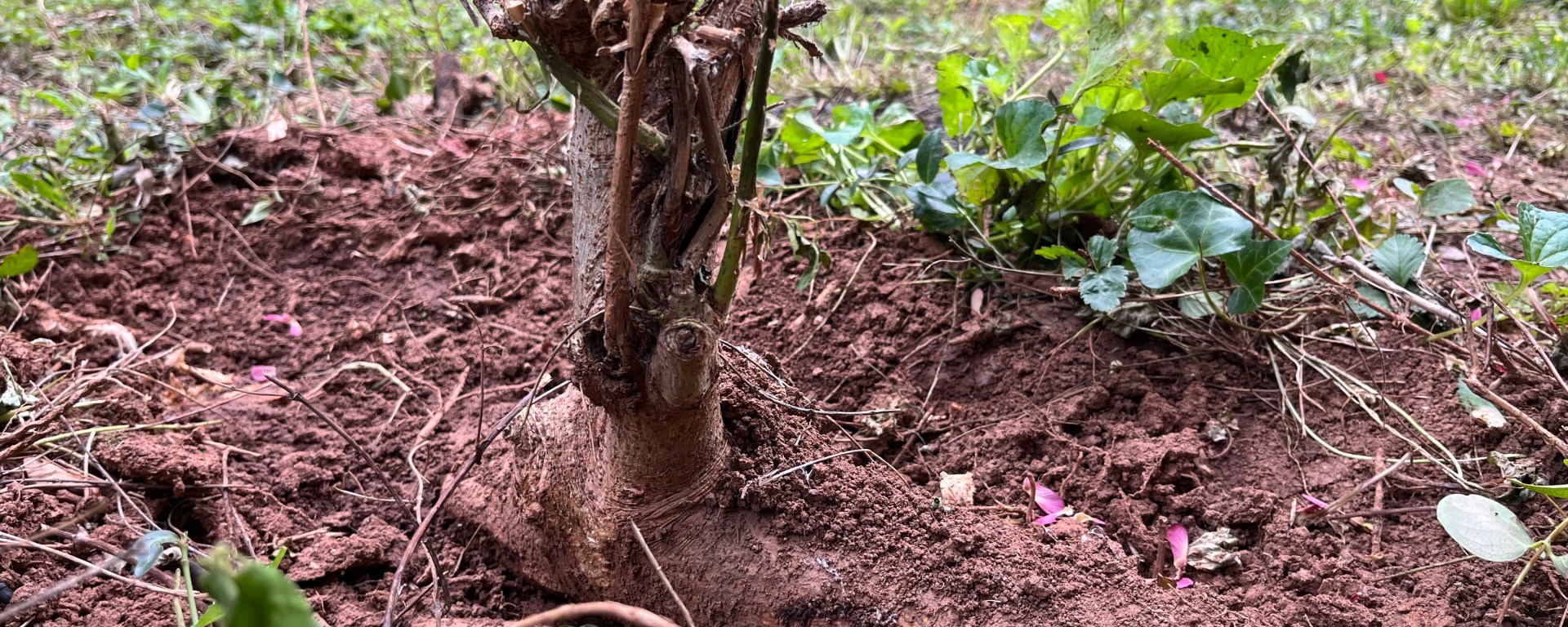
On Friday, my day off, I spent the morning in our yard. When we moved to Lynchburg, we had a line of invasive trees on the edge of our property— the edge of where someone before us might’ve been mowing. These trees were pretty big: 20-30 feet tall, 6-18 inches wide. We took down a few on our own, then a couple more, and then finally had someone come to take out the big ones and make room so we could put up a fence for our dogs. It took more than a year to get the trees mostly down. These are paper mulberries, by the way. When we took them all down, we thought we had seen the last of them, at least in the fenced-in part of our yard… unfortunately, I don’t think we realized how resilient their root system has been. Three weeks ago I pulled dozens of 3 foot tall trees out of our yard; and on Friday, I pulled most of them a second time— from buried stumps and exposed roots and seemingly from nowhere at all— they just keep coming. For those reading along, you can see one of the stumps in the cover photo on this post! But fortunately for me; after a hard morning’s work, I opened my Bible and read this parable and the first part of the good news— Jesus says, “no more weeding!”
Now— all weeding jokes stories aside, I want to remind you of the parable Jesus tells this morning. The parable comes in two parts, a parable and an explanation. When we read Jesus’ parables we have to remember that we can never reduce them to one definition, or one interpretation— not even when Jesus gives an interpretation later in the narrative. No, Jesus always means for the parables to speak on many levels, to those who do not know him, and those who know him intimately; to bewilder those who understand and to enlighten those who feel ignorant.
So first we read the parable. The story is about the Kingdom of Heaven— already in Matthew’s gospel something that has two meanings. The Kingdom of Heaven is our ultimate destination, a destination that those in Matthew’s time would have seen as imminent for the whole world— for they believed Jesus would come again in their lifetimes. It is also the mission of Jesus— through him, in real time, the kingdom is breaking into the world as is— disrupting the structures of society and class, the power of the state and the religious order, and setting all things to how they should be. So— the kingdom is coming, and it is already here among us.
Jesus compares the kingdom to a farm. In the fields, there are good and bad seeds— good and bad plants. The instinct of those within the household are to pull the weeds as soon as they are started; but the instinct of the farmer is to wait— wait until harvest. Then we will separate good from bad, weeds from wheat.
The parable’s message is simple. We may think we can tell good from bad, but we cannot. Only at harvest time, only at the final judgement, will God reveal what is truly good or bad. Only through the judgement of God can we be redeemed; only through God’s work in Jesus Christ can we be set free from evil and death and offered eternal life. The parable lines up with so many of Jesus’ teachings— don’t judge others, lest you miss the log in your own eye for the speck in your neighbor’s. Be patient— for you do not know the time and place in which the master will return to the household. I will gather the wheat— what is good and true and beautiful in the world, and bring it into the kingdom of heaven, the barn, at the harvest time. Our role in all this is not to pass judgement, but to offer grace. Our role is not to choose who is in, or out, but to extend the possibility of growth to all; for we cannot really tell the difference between good and evil in an eternal way. The parable invites us to be patient— to leave the harvest to God, and simply to tend the fields; to aid God in scattering seeds, as last week’s parable of the sower reminds us.
So what then do we make of Jesus’ own interpretation? He makes the weeds and wheat people— children of the evil one, and children of God, respectively. The harvest is the final judgement, the enemy is the devil and Jesus, the Son of Man, is the farmer. Jesus does not say who the slaves are— those who would pluck up the weeds early— but he does specify the reapers, a different group, will be angels, not us. Those angels will collect up all causes of sin— all causes of sin — and all evildoers; and separate them out. No matter how evil, no matter how powerful, God will ultimately judge and resolve it. That is Good News. Sin? It’s gone. The Devil? Taken care of. Racism? Sexism? Homophobia? Poverty? Injustice? Solved. Jesus’ explanation is finally about the completion of God’s plan, of God’s redeeming power over the world to set all things right, and invite all into his heavenly kingdom. He’s focused on the future part of this parable— not the now part. Not those who are living amidst weeds and wheat, unsure of which thing is which.
I don’t want to ever say there is bad news, but this is difficult news in this text. The world we live in, the church we are a part of, is a mixed world, a mixed church. There is good, and evil, in both. We’ve all seen evil in one form or another— whether that is through people, society, or all the above. We’ve been hurt by those whom we trusted, who we thought we judged rightly. It has also gone the other way. People we believed to be evil turned out to be good. Whole portions of the world that we held one opinion of a generation ago are now given their due, while we hold on to a residue of a judgement that was unjust from the beginning. We are victims, and perpetrators of evil— its roots are entangled in our own.
So God’s counsel is to be patient, yes, but not patient with evil. Patient with people. We are not to offer a final judgment on people or groups, for if we set one, even just one person down as irredeemable, then at the first hint of evil we must put ourselves on that side of the ledger as well. People change— people grow. People are redeemed. People fail us. People try again. The Good News is that we all contain multitudes; God calls us all to bear good fruit. But it is not by our own hand that we are redeemed— we are redeemed by him who is the good sower, the wise householder, the shepherd, who lays down his life for the sheep. Amen.
 Ben Cowgill